Kenyan Teacher's Mission to Wire His School for the Future
By John Kabubu
Deep in the heart of Laikipia County, the sun rises, presenting with it yet another opportunity to wake up and try again. They say that the best way to prepare for the future is to predict it. And the best way to predict the future is to plan for it.
Along the corridors of Tigithi Boys Secondary school, students walk determinedly, one step after the next, on their way to school to attempt to predict the future by planning for it. Uniforms are neat, as if just freshly washed, dried and ironed. Their faces shine brightly, oiled by the fuel of focus, discipline and a burning desire for a brighter future that cannot be extinguished. In this not-so-distant future, they march, one after the other, towards big dreams, their conversations sprinkled with plans for the day, occasionally interrupted by rambunctious laughter following a joke by one of the happier students.Samuel Irungu, a dedicated physics and computer teacher at the school, emerges from the shadows, hurriedly helping the boys move quickly towards their classes. He reminds them that time is not on their side and they need to settle down quickly for classes to begin.
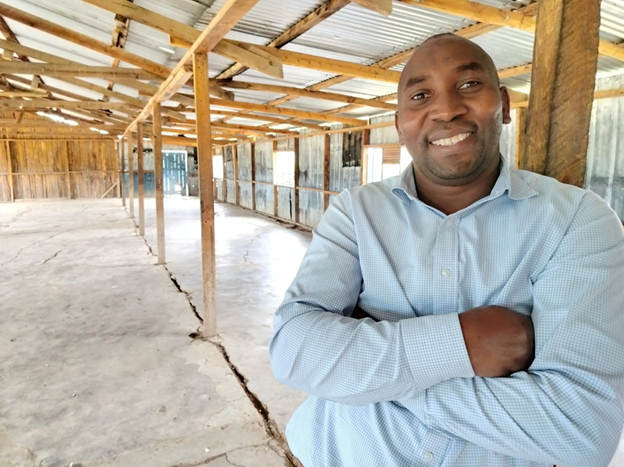
Tigithi Boys Secondary School, with a population of 250 students and a teaching staff of 19, is quietly closing a global divide. For years, the "digital literacy gap" was not just a concept here, but a daily reality. While students elsewhere navigated the digital world with excitement and ease, the young minds of Tigithi were cut off, their potential limited by a lack of internet and reliable power.
That was before the arrival of ARES in 2017. ARES Education provides hands-on STEM learning for students through project-based activities, many of which are built around a self-contained kit called the "ARES Learning Lab." This portable box contains all the necessary hardware and pre-loaded software for coding, robotics, and data collection, allowing students to engage in complex STEM lessons without requiring a constant internet connection.
Samuel Irungu, a dedicated Physics and Computer teacher for the last 12 years, has witnessed what ARES can do when deployed effectively. "Initially, we viewed a computer as a vice, something not good for the students," he recalls, alluding to the fear and misunderstanding that often surrounded technology. "We struggled."
Teaching complex physics concepts without practical demonstrations was an uphill battle. Student performance languished below 4%. Computer studies were a theoretical exercise for exams, not a practical skill.
Then, in 2023, a new and improved ARES system was installed—a rugged server filled with an entire universe of knowledge, operating entirely offline. Dubbed the "ARES box" by the students and teachers, it became the school's digital oasis.
The Revolution Will Not Be Televised; It Is Here!
For Mr Irungu, ARES optimised how he teaches. "The ARES box has assisted me in easier delivery of information," he explains. "Some of the practicals that are supposed to be handled in the science laboratory... ARES makes it simple and enjoyable, making the understanding better," he says excitedly.
Gone are the days of laborious and long-winded explanations. Now, he can pull up interactive simulations, videos, and digital quizzes. He collects editable notes from ARES, combines them with textbook materials, and creates powerful, customised lessons for his students. The result? A shift in both engagement and performance.
To the ordinary observer, a 3% improvement in performance is not noteworthy or even something to brag about. Not for Samuel Irungu. To him, with everything he has experienced as a teacher over 12 years, this ‘minuscule’ improvement means the world. It means that something is working and things are shifting in the right direction.
"The performance of physics was much below 4%. But in the classes where we use ARES, the performance is going up to 7%," Samuel states with a wide and genuine smile on his face. "The class sometimes becomes almost the same size as the biology class because the students have increased in learning, understanding and liking the subject,” he exclaims.
Students Re-awakened, Eager for More
The students are now self-motivated explorers. They flock to the computer lab to learn on their own, with Mr Irungu acting more as a guide than a teacher. The desire to learn is so fierce that it even keeps students in school. "Some students, when they are sent home for school fees, and it is the day they are supposed to access the ARES box, they absolutely refuse," he shares. "They say, 'Today we have ARES class, we will leave tomorrow.” As exams approach, the demand intensifies. Students bring fresh work from the ARES system to Mr Irungu’s office, their enthusiasm so overwhelming that he jokes, "Sometimes I'm forced to sleep in school because the work is too much for printing and marking."
The most profound change, however, is in the students themselves. The ‘box’ has become a box for learning.
"After the introduction of the ARES, our students have come up with a positive attitude towards the computer," Samuel notes. The proof is in the discipline: "For the last five years, we have not done any vandalism concerning the computer laboratory."
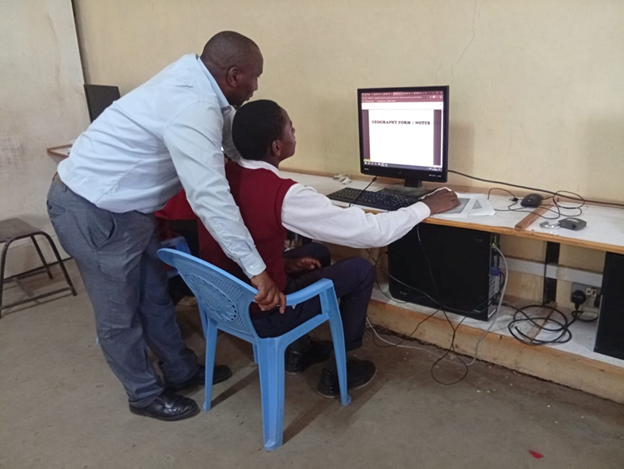
The students are now self-motivated explorers. They flock to the computer lab to learn on their own, with Mr Irungu acting more as a guide than a teacher. The desire to learn is so fierce that it even keeps students in school. "Some students, when they are sent home for school fees, and it is the day they are supposed to access the ARES box, they absolutely refuse," he shares. "They say, 'Today we have ARES class, we will leave tomorrow.”
As exams approach, the demand intensifies. Students bring fresh work from the ARES system to Mr Irungu’s office, their enthusiasm so overwhelming that he jokes, "Sometimes I'm forced to sleep in school because the work is too much for printing and marking."
Brighter Futures
Looking at the future, Samuel Irungu sees a path illuminated by ARES screens. "With the introduction of ARES, the future is brighter than the present and the past," he declares. He dreams of expanding this digital oasis beyond the single computer lab of ARES networks, reaching individual classrooms and tablets, putting a world of knowledge directly into every class.
"Evidence is in this: students now are self-motivated... If we continue this, it will help the practicals to be easier, it will help the performance to improve, and it is also adding value to the discipline," he says. "Therefore, I can say the future is brighter than today."
In a rugged part of Kenya, a school is no longer on the wrong side of a digital divide. Thanks to ARES and the dedication of teachers like Samuel Irungu, Tigithi Boys is not just catching up; it is charging forward, its students empowered, curious, and ready to claim their place in the wider world. By making advanced technology accessible anywhere, ARES transforms students from passive learners into active problem-solvers, equipping them with critical skills for future academic and career success.